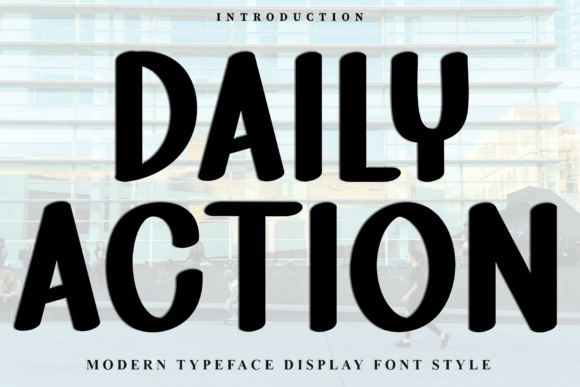
Daily Action Font: Elevating Digital Brand Identity
In the competitive landscape of web design and digital product creation, typography is often the primary vehicle for brand personality. While functional sans serif fonts handle the heavy lifting of body copy and navigation, a distinctive display typeface like Daily Action serves as the emotional anchor of a user interface. Designed with a soft, unique touch, this font offers web designers and UI creators a versatile tool for establishing visual hierarchy without sacrificing digital readability. Its distinctive strokes provide a special character that translates exceptionally well across hero sections, landing pages, and branded content areas where capturing attention is paramount.
Visual Character and Digital Personality
Daily Action distinguishes itself from standard geometric or humanist display fonts through its organic fluidity. The softness in its stroke terminals creates an approachable, human-centric aesthetic that is increasingly valuable in digital spaces dominated by rigid grids and sterile interfaces. For a web designer, this means the typeface carries inherent warmth, making it ideal for brands that need to convey trust, creativity, or personal connection. Unlike harsh, high-contrast display fonts that can feel aggressive on backlit screens, the gentle curves of Daily Action reduce visual friction, encouraging users to linger longer on key messaging.
This font performs best when treated as a strategic design asset rather than mere decoration. Its unique letterforms possess enough weight to hold their own against busy background imagery or solid color blocks, yet they retain enough delicacy to feel premium. This balance is critical for modern web experiences where the line between editorial elegance and functional clarity must be carefully maintained. When used in a digital context, Daily Action signals intentionality, suggesting that the brand behind the screen has invested in a cohesive, thoughtful visual identity.
Strategic Applications in Web Layouts
The versatility of Daily Action allows it to function effectively across various touchpoints in a digital ecosystem. As a display font, its primary role is to guide scanning behavior and establish immediate context. Here are practical applications where this typeface excels:
- Hero Section Headlines: Use large-scale Daily Action typography to anchor the top fold of a landing page. The unique strokes create a focal point that draws the eye immediately, increasing the likelihood of engagement with the primary value proposition.
- Call-to-Action Accents: While not recommended for small button text due to legibility constraints at low sizes, Daily Action works beautifully for CTA labels above buttons or as directional cues that lead users toward conversion points.
- E-commerce Banners: For boutique online stores or lifestyle brands, this font adds a layer of sophistication to promotional banners. It elevates product photography by providing a typographic texture that feels handcrafted rather than mass-produced.
- Content Marketing Headers: In blog layouts or course sales pages, using Daily Action for H2 and H3 tags breaks up long-form content, creating a rhythmic reading experience that prevents user fatigue.
- Digital Ad Creatives: Social media graphics and display ads benefit from the font’s distinct silhouette, which remains recognizable even when scaled down for mobile feeds.
Optimizing Readability and Responsive Behavior
A beautiful font fails if it cannot be read on a smartphone. When integrating Daily Action into responsive web designs, technical considerations must accompany aesthetic choices. Display fonts with unique characteristics require careful handling to ensure accessibility and performance across devices. On mobile screens, where horizontal space is limited, it is crucial to test line breaks and hyphenation. The soft strokes of Daily Action can sometimes merge at very small sizes, so maintaining a minimum font size threshold—typically 24px or higher for headings—is advisable to preserve the integrity of the letterforms.
Contrast ratios also play a significant role in digital usability. Because of its softer edges, Daily Action requires sufficient contrast against its background to meet WCAG standards. Designers should avoid placing this font over complex, high-frequency textures without a scrim or overlay. On dark backgrounds, slightly increasing the tracking (letter-spacing) can improve legibility by preventing the soft strokes from visually bleeding together. Conversely, on light backgrounds, ensuring adequate weight is selected will prevent the typeface from appearing washed out on high-resolution retina displays.
Effective Font Pairing Strategies
Daily Action shines brightest when paired with typefaces that provide structural stability. The goal of font pairing in web design is to create tension and harmony; the display font provides the voice, while the supporting font provides the skeleton. For a modern SaaS or tech-forward brand, pairing Daily Action with a clean, geometric sans serif like Inter or DM Sans creates a compelling juxtaposition between organic creativity and digital precision. This combination works exceptionally well for landing pages that need to feel innovative yet reliable.
For editorial sites, coaching platforms, or luxury e-commerce, consider pairing Daily Action with a refined serif font for subheadings or pull quotes. This creates a layered typographic system that feels curated and magazine-like. Alternatively, a neutral grotesque sans serif for body copy ensures that the reading experience remains effortless, allowing Daily Action to serve purely as an accent without competing for cognitive load. Avoid pairing it with other script or highly decorative handwritten fonts, as this creates visual noise and dilutes the impact of both typefaces.
Technical Implementation and Licensing
Before deploying Daily Action in a live environment, web designers must verify the technical specifications and licensing terms. Ensure that the webfont files (WOFF2 format is preferred for performance) include the necessary character sets for your target audience. If the project involves multilingual support, confirm that the font includes extended Latin characters or specific glyphs required for localization. Additionally, check for OpenType features such as stylistic alternates or ligatures, which can add further customization to headers and logo treatments without requiring custom CSS hacks.
Licensing is a non-negotiable aspect of professional web design. Commercial font licensing for websites typically differs from desktop licensing. Verify that your license covers the expected monthly pageviews and includes permissions for use in digital templates, client projects, and embedded web applications. Using a premium font like Daily Action correctly protects both the designer and the client from legal issues while supporting the type foundry. Proper implementation also involves setting appropriate font-display properties in CSS to prevent invisible text during loading, ensuring that the user experience remains smooth even on slower connections.
Building Consistent Brand Systems
Beyond individual pages, Daily Action can serve as a cornerstone of a comprehensive digital brand kit. Consistency breeds trust, and having a defined typographic hierarchy ensures that every digital touchpoint feels connected. Document the specific use cases for this font within your design system: define maximum and minimum sizes, approved color combinations, and spacing rules. By codifying how Daily Action interacts with other interface elements, you empower other designers and developers to maintain brand integrity as the website scales.
Ultimately, the value of Daily Action lies in its ability to humanize digital interfaces. In an era where users are inundated with generic templates and stock aesthetics, a typeface with genuine character offers a pathway to differentiation. Whether applied to a creative portfolio, a wellness app, or a direct-to-consumer store, it provides the visual nuance necessary to transform a functional layout into a memorable brand experience. By balancing its artistic qualities with rigorous usability standards, designers can leverage this font to create web experiences that are not only visually striking but also effective at driving user engagement and conversion.